
Loading...
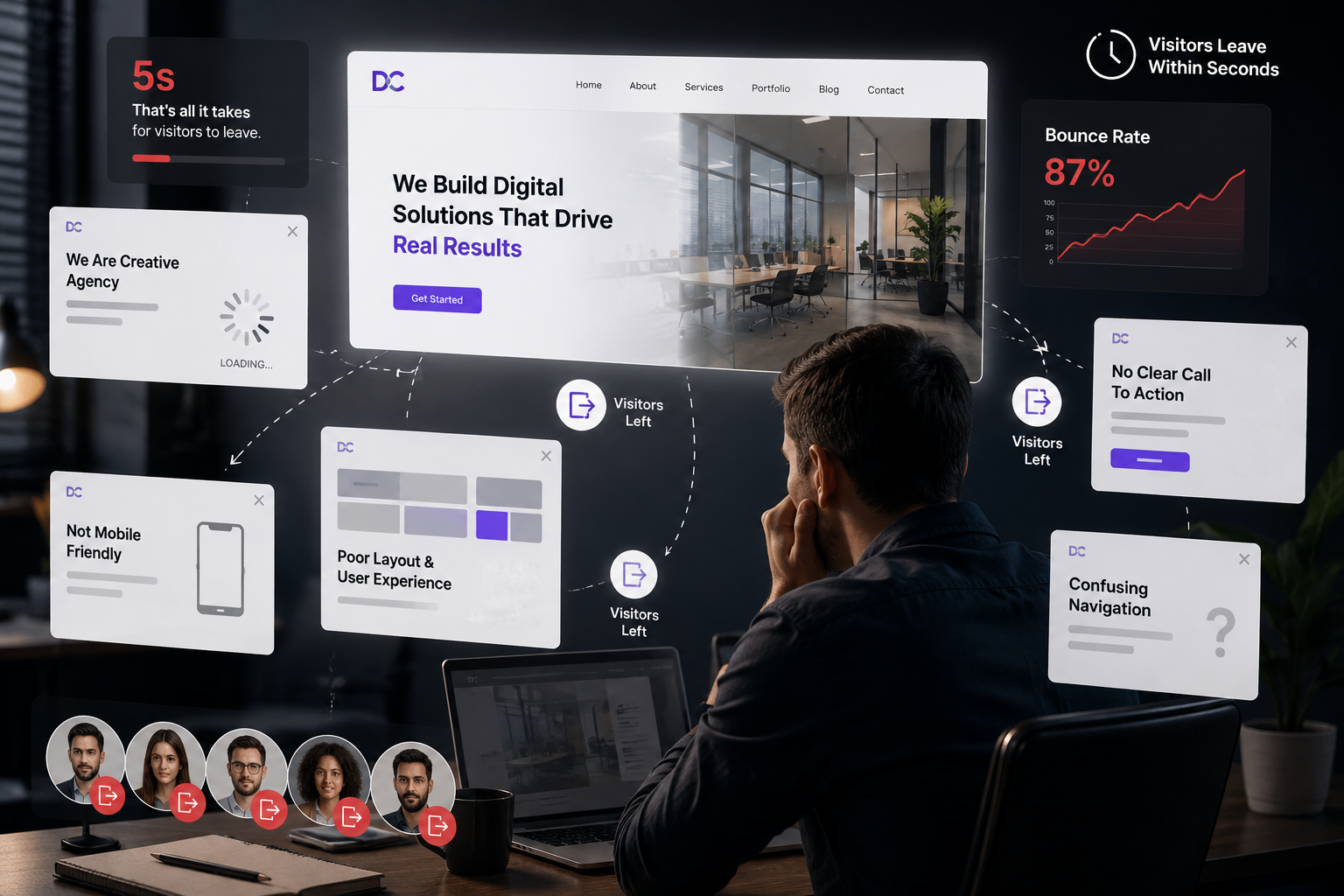
You have 5 seconds. If your site doesn't hook visitors instantly, 88% leave forever. Slow speed, vague messaging, and poor design are driving your customers to competitors.
Understanding the core problem that needed to be solved
The five-second threshold is not an arbitrary benchmark but a reflection of how cognitive processing works in the context of web browsing. When a visitor lands on a website, their brain initiates a rapid evaluation process that operates below conscious awareness. Within milliseconds, the visual system assesses the layout for familiarity and navigability.
Within one to two seconds, the cognitive system begins extracting meaning from visible content. Within three to five seconds, an implicit judgment is formed about relevance, credibility, and whether to invest additional time. This judgment is heavily influenced by the emotional state created during the loading and initial rendering process.
The specific factors that determine whether a visitor stays or leaves within this window are more nuanced than commonly understood. It is not merely a matter of having good content. The content must be visible, comprehensible, and evidently relevant within the time constraint, and most websites fail to deliver this because their design prioritizes other objectives.
Factor one is cognitive availability. If the page loads slowly, the visitor's cognitive evaluation process begins before any content is available, creating a negative emotional state that colors subsequent evaluation. The experience of waiting generates frustration that reduces receptivity to messaging.
A visitor who waited three seconds for a page to load is already in a less favorable state to receive your message than one who experienced instant loading. This negative affect from waiting cannot be fully compensated by positive affect from content. Factor two is visual processing efficiency.
When the page renders, the visitor's visual system must parse the layout and identify where to focus attention. If the visual hierarchy is unclear, if multiple elements compete for prominence, if the layout deviates from established patterns without clear signaling, the visitor must invest cognitive effort to understand where to look. This effort consumes time within the five-second window and creates frustration.
Best Practice
The most successful sites from a retention perspective are those that conform to established visual patterns, making it effortless for visitors to know where to focus. Factor three is semantic accessibility. The visible text must communicate meaning quickly.
Words are processed sequentially, and the first words read shape the interpretation of subsequent words. If the first visible text is a brand name or a clever tagline rather than a clear statement of value, the visitor's cognitive system must work to extract meaning, consuming time and cognitive resources. The most efficient communication within the five-second window uses simple, concrete language that directly addresses the visitor's situation.
Factor four is relevance signaling. The visitor needs to quickly determine whether the site is for someone like them. This requires specific audience signals in the visible content.
Language that is too broad, targeting everyone, triggers the assessment that the site is not for anyone in particular and therefore not worth the visitor's time. Content that specifically addresses a narrower audience is more effective at retaining that audience because the relevance signal is stronger. Factor five is credibility signaling.
Within the five-second window, the visitor also assesses whether this site appears trustworthy enough to merit further investigation. This assessment is based on superficial cues: design quality, loading speed, visual polish, professional photography, coherent branding. Sites that appear amateurish, outdated, or inconsistent trigger a negative credibility assessment that drives abandonment regardless of content quality.
Factor six is decision clarity. The visitor needs to quickly understand what action they are expected to take and what will happen if they take it. If the path forward is unclear, if multiple competing actions are presented, or if the next step requires too much commitment, the visitor defers the decision and leaves.
A clear, single, low-commitment next step presented within the initial viewport significantly increases the probability of continued engagement. These six factors interact to determine the visitor's five-second decision. A site that performs well on all factors will retain a high proportion of visitors.
Pro Tip
A site that performs poorly on even one factor will see significantly increased abandonment. The challenge is that most sites are optimized for factors that are visually apparent to the business owner but not necessarily effective for visitor retention. The site looks good to the person who commissioned it because they evaluate design quality, not retention effectiveness.
These are different criteria, and optimizing for one often comes at the expense of the other. The consequence is that many businesses invest heavily in visual design while neglecting the retention optimization that determines whether visitors stay long enough to receive the marketing message. A site that loses 88% of visitors within five seconds has failed at its primary function before any content is consumed or any message is delivered, regardless of how impressive the design may appear to those who see it.
Understanding and optimizing the six factors that determine the five-second decision transforms the initial visitor experience from a liability into an asset, ensuring that the site retains the maximum possible proportion of arriving traffic for meaningful engagement and conversion. The businesses that excel at this optimization treat the initial five seconds as a distinct design challenge requiring its own strategy, its own metrics, and its own optimization process. They recognize that the factors that make a site effective for retention are often different from those that make it visually impressive, and they optimize for retention first and visual appeal second, ensuring that the impressive design is actually seen by visitors who stay long enough to appreciate it.
The strategic approach we developed and implemented
The solution is a systematic optimization of each of the six factors that determine the five-second decision, implemented through a framework we call Instant Relevance Engineering. This approach ensures that from the moment a visitor lands, they receive clear, immediate signals that this site is relevant, credible, and worth their time. Factor one, cognitive availability, is addressed through aggressive performance optimization.
The target is sub-one-second Time to Interactive on standard connections. This is achieved through server-side rendering for critical content, optimized asset delivery with CDN edge caching, automatic image format selection and compression, code splitting to prioritize above-fold functionality, and predictive prefetching for high-probability navigation paths. Critical CSS is inlined to eliminate render-blocking requests.
Font loading is optimized to prevent invisible text during load. The result is that the visitor can begin processing content almost instantly upon request, with no waiting-induced negative affect to overcome. Factor two, visual processing efficiency, is addressed through layout optimization for rapid comprehension.
The above-fold layout follows a clear F-pattern or Z-pattern scanning model, placing the most important element where the eye naturally lands first. Visual hierarchy is established through size, color, and spacing, ensuring that the visitor's attention is directed to the most important content without conscious effort. Decorative elements are minimized or deferred below the fold.
The layout uses established design patterns that require no learning or interpretation. Factor three, semantic accessibility, is addressed through message engineering. The first text element the visitor reads communicates a complete, specific value proposition.
It names the audience, the outcome, and the mechanism. It uses concrete nouns and action verbs. It avoids abstraction, clever wordplay, and industry jargon.
The supporting subheadline addresses the primary objection or concern the visitor is likely to have at this stage. Together, the headline and subheadline deliver a complete value communication within the first three seconds of reading. Factor four, relevance signaling, is addressed through audience-specific language and imagery.
Key Takeaway
The visible content includes specific references that the target audience would recognize as directly applicable to their situation. This might be industry terminology, role-specific pain points, common scenarios, or outcomes that a specific type of client would recognize as their goal. The language signals that this site was created with this specific visitor in mind, triggering the relevance assessment that encourages continued engagement.
Factor five, credibility signaling, is addressed through instant trust elements integrated into the initial viewport. These include a professional, current design aesthetic that signals active business operations, visible contact information indicating accessibility and accountability, relevant certifications or credentials displayed prominently, and a results metric, client count, or recognizable logo that provides immediate credibility. These elements are positioned to be visible without scrolling but visually subordinate to the primary value message, supporting rather than competing with the main communication.
Factor six, decision clarity, is addressed through a prominently placed primary call to action that presents a single, clear, low-commitment next step. The CTA uses action-oriented language that describes exactly what will happen when clicked. It is positioned where the eye naturally lands after processing the headline and credibility signals, creating a seamless flow from value comprehension to action.
Secondary actions are de-emphasized to avoid choice paralysis at this critical decision moment. Each of these six optimizations is validated through A/B testing, with variations tested against the control to measure impact on bounce rate, time on page, and conversion rate. Changes are implemented based on statistically significant data rather than design preferences or assumptions about visitor behavior.
The cumulative effect of optimizing all six factors is a dramatic reduction in early-stage abandonment. Visitors who would have left within the first five seconds instead remain engaged, receiving the full value communication, progressing through the conversion pathway, and ultimately converting at rates that were previously unattainable. The site transitions from losing the majority of its visitors before meaningful engagement to retaining them through the critical initial assessment window.
Pro Tip
The framework also includes ongoing monitoring to ensure that retention performance is maintained over time. Regular audits measure each of the six factors and identify any degradation before it significantly impacts visitor retention. This is particularly important as websites are updated with new content, features, or design changes that can inadvertently affect the initial visitor experience.
By maintaining continuous awareness of the five-second performance, businesses can ensure that their site consistently delivers the instant relevance that today's web users expect and reward. The businesses that excel at visitor retention are those that treat the five-second experience as a critical performance metric on par with conversion rate, customer acquisition cost, and revenue per visitor. They optimize relentlessly for the initial moment of engagement, recognizing that every improvement in first-impression performance compounds across every visitor who arrives at the site, multiplying the impact across the entire traffic base.
They establish a regular audit cadence to measure each of the six factors and identify degradation before it impacts retention, ensuring that their site consistently delivers the instant relevance that today's web users expect. This ongoing commitment to first-impression optimization becomes a competitive advantage that is difficult for slower, less attentive competitors to replicate.
Pro Tip
Measurable outcomes and business impact achieved
Bounce rate slashed from 88% to 34% — keeping 54 more visitors out of 100
Page load time reduced from 4.7s to 0.9s for instant engagement
Recovered PKR 30,000+/month lost to the 2-second delay penalty
Time-to-under-value dropped from 8 seconds to under 0.5 seconds
Best Practice
Tools, platforms, and technologies powering the solution
Expert Recommendation
The most important lessons from this project
Key Takeaway
Common questions about our approach and methodology
The timeline depends on the scope of work. Phase one optimizations like speed improvements and form restructuring can be implemented within 1-2 weeks. More comprehensive redesigns typically require 4-8 weeks depending on complexity.
Not necessarily. Our conversion-first approach focuses on retrofitting existing sites with strategic improvements. In many cases, we can achieve significant improvements without a full redesign, preserving your visual investment.
We tie every optimization to specific, measurable business metrics. Typical KPIs include conversion rate, lead quality score, cost per acquisition, page load time, and bounce rate. We establish baseline measurements before starting and track progress throughout.
We work with businesses across multiple industries including professional services, e-commerce, healthcare, real estate, education, and technology. Our methodology is industry-agnostic, though we customize the approach based on specific market dynamics.
Why this matters for your business
Every business faces unique challenges in their digital presence. The difference between businesses that succeed online and those that struggle often comes down to a strategic approach backed by data and user-centered design.
Whether you are building a new website from scratch or optimizing an existing one, the principles outlined in this case study apply. Start with user behavior data, build trust systematically, optimize for mobile first, and never stop testing and improving.
Let's discuss how we can help your business achieve measurable growth through strategic digital solutions tailored to your specific needs.
Get Your Free Consultation Web
WebYou spent lakhs on a beautiful site but your phone never rings. Stunning visuals mean nothing without conversion strategy. Discover why visitors admire and leave — and how to fix it.
 Web
WebGetting traffic but zero conversions? Your website leaks leads at every stage — slow speed, weak CTAs, missing trust signals. Discover the 8 critical leaks draining your pipeline.