
Loading...

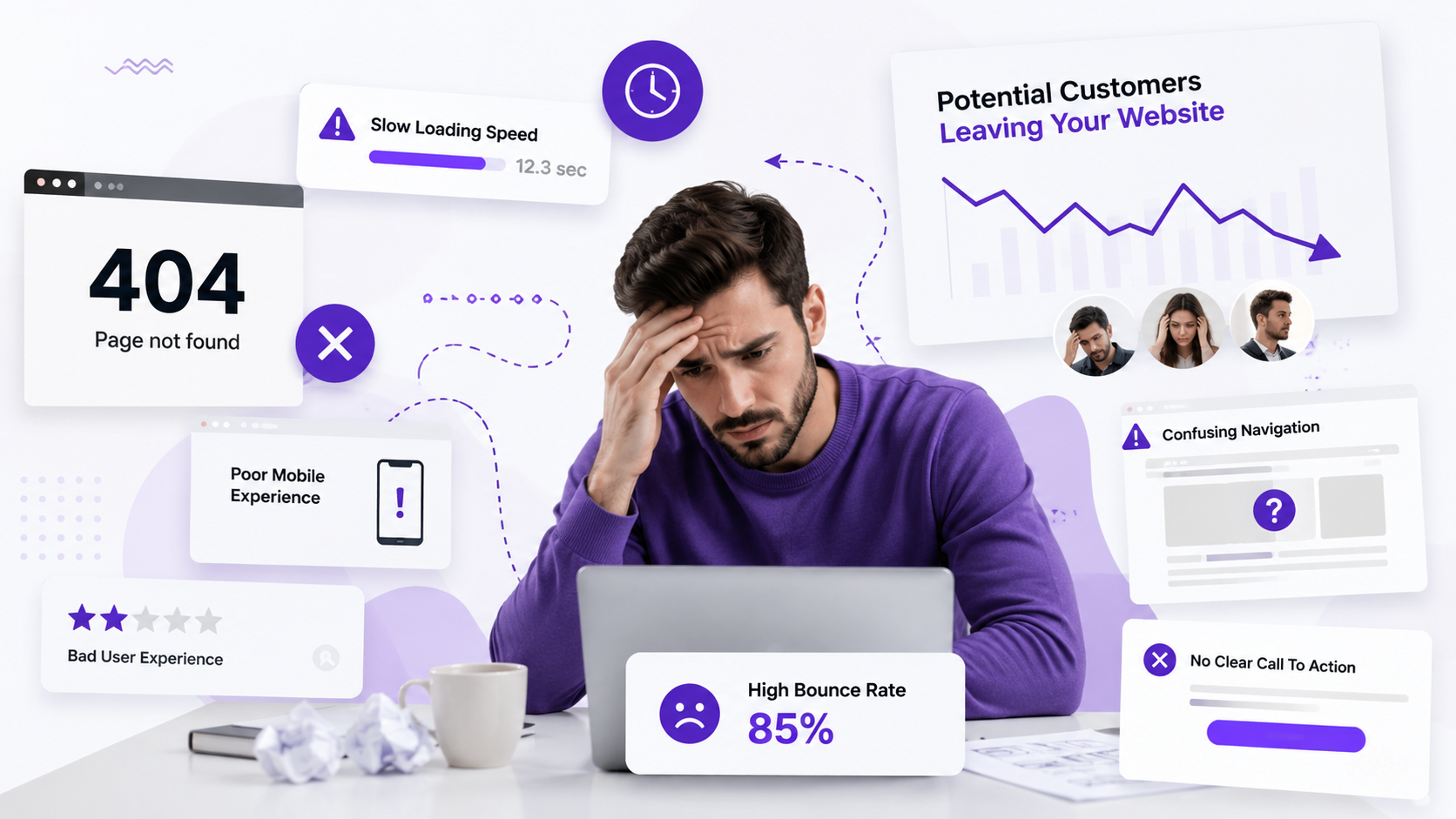
Getting traffic but zero conversions? Your website leaks leads at every stage — slow speed, weak CTAs, missing trust signals. Discover the 8 critical leaks draining your pipeline.
Understanding the core problem that needed to be solved
The situation is deceptive because the symptoms are misleading. Traffic numbers appear healthy. Analytics show a steady flow of visitors.
Advertising campaigns are delivering clicks. Yet the contact form remains empty, phone calls do not come, and the business questions whether digital marketing works at all. The natural but incorrect conclusion is that more traffic is needed, leading to increased advertising spend on a fundamentally broken system.
The reality is that the website itself is structurally incapable of converting traffic into leads, and no amount of additional traffic will solve a conversion problem. The breakdown occurs through multiple distinct leaks, each operating at a different stage of the visitor journey and each draining a portion of potential conversions until little to nothing remains. Understanding each leak is essential because they require different fixes, and fixing only one or two while leaving others intact will not produce meaningful improvement.
Leak one is the speed and accessibility leak. When a visitor clicks a link to your site, they begin an implicit evaluation. If the page does not become interactive within approximately three seconds on a mobile connection, a significant percentage will abandon before seeing any content.
This is not a matter of patience but of expectation. The web has trained users that fast-loading sites are the norm, and slow sites are interpreted as unprofessional or technically incompetent. Before any marketing message is delivered, before any value is communicated, before any trust is built, a substantial portion of potential leads is lost to speed alone.
Leak two is the relevance assessment leak. Visitors who survive the speed filter scan the visible content for relevance signals. Within seconds, they subconsciously ask: is this for someone like me, does this address my situation, should I invest more time here.
If the above-the-fold content fails to communicate relevance clearly, using generic messaging that could apply to any company in the industry, visitors conclude the site is not for them and leave. This leak is particularly insidious because it affects high-quality prospects first. Sophisticated buyers are efficient at relevance assessment and will abandon quickly when relevance is unclear, leaving only less discriminating visitors who are also less likely to convert.
Pro Tip
Leak three is the credibility evaluation leak. Visitors who have established relevance then evaluate whether the company is credible enough to trust with their business. They look for evidence: case studies, testimonials, client logos, results data, methodology descriptions, team credentials.
If these elements are absent, buried in secondary pages, or insufficiently detailed, the visitor may remain interested but not confident enough to take action. They bookmark the site intending to return, but most never do. Leak four is the decision architecture leak.
Even when a visitor is interested and the site is credible, the path to conversion must be clear and easy. If the call to action is buried, confusing, or requires multiple steps, if the contact form asks for excessive information, if the next step is not obvious, the visitor hesitates. In that moment of hesitation, distraction intervenes and the potential lead is lost.
Leak five is the mobile conversion leak. If the mobile experience is a compromised version of the desktop site, the majority of visitors who arrive on mobile devices encounter navigation difficulties, slow loading, hard-to-use forms, or content that requires excessive zooming and scrolling. These visitors may be interested but unable to conveniently convert through their device.
Many intend to return on desktop but few actually do. Leak six is the trust threshold leak. For high-value services involving significant investment or risk, visitors need to cross a trust threshold before they are willing to provide contact information.
If the site does not progressively build trust through the visitor journey, if it asks for contact information before sufficient trust has been established, the visitor balks. They need more evidence, more information, more reassurance before they are willing to identify themselves. Leak seven is the follow-up leak.
Even when a visitor does complete a form, if the response is slow, generic, or impersonal, the lead may cool off or pursue alternatives before meaningful contact is established. The conversion was achieved but the follow-up failed to capitalize on it. Leak eight is the re-engagement leak.
Key Takeaway
Most first-time visitors do not convert on their initial visit regardless of site quality. They need multiple exposures before they are ready to engage. If the site has no mechanism for re-engaging these visitors through retargeting, email capture, or content marketing, the vast majority of initial interest is permanently lost.
These eight leaks compound each other in a way that makes the whole system far less effective than the sum of its parts would suggest. The speed leak feeds the relevance leak, which feeds the credibility leak, which feeds the decision architecture leak. A visitor who experiences slow loading is more likely to interpret vague messaging negatively.
A visitor who finds the relevance unclear is less likely to persist through navigation complexity. A visitor who is uncertain about credibility is more likely to abandon at the first sign of form friction. Each leak makes the next leak more severe, creating a cascade of abandonment that leaves a tiny fraction of the original traffic reaching conversion.
Closing one leak without addressing the others produces minimal improvement because the remaining leaks continue to operate in sequence, draining conversions at each subsequent stage. The only effective approach is systematic identification and closure of all leaks in a coordinated program that addresses the entire conversion pathway. Even if each leak only reduces conversions by 30%, the cumulative effect of eight sequential 30% reductions is that less than 6% of potential conversions survive.
The site is not failing at one thing. It is leaking at every stage, and fixing requires addressing each leak systematically. Beyond these eight technical leaks, there is a deeper organizational problem.
Most businesses lack the data infrastructure to even detect that these leaks exist. They measure vanity metrics like traffic volume and page views while remaining blind to conversion performance. The contact form submission count is known, but the number of visitors who intended to submit but abandoned the form is unknown.
The phone calls that were never made cannot be counted. The leads that would have converted if the site had been optimized remain invisible. This data blindness perpetuates the cycle of underperformance because the business has no way to diagnose the problem or measure the impact of improvements.
The strategic approach we developed and implemented
The solution is a comprehensive conversion leak detection and repair program that identifies, measures, and seals each of the eight leaks in order of revenue impact. The process begins with a diagnostic phase that quantifies the current leak severity at each stage, then proceeds through targeted interventions for each leak, with the impact of each intervention validated through conversion data. The diagnostic phase deploys multiple data collection tools simultaneously.
Google Analytics 4 provides quantitative data on visitor flow, page-level engagement, and conversion path analysis. Session recording tools capture actual visitor behavior, showing where they hesitate, where they click in confusion, and where they abandon. Heatmap and scroll map tools visualize engagement patterns across each page.
Form analytics tools measure field-level interaction on contact forms. This data is synthesized into a conversion leak report that quantifies the drop-off rate at each stage of the visitor journey and calculates the revenue impact of each leak. For the speed and accessibility leak, the intervention is a comprehensive performance optimization program.
This includes image compression and next-gen format conversion targeting 80% reduction in image weight, code minification and bundling to reduce HTTP requests, render-blocking resource deferral, browser caching implementation, content delivery network deployment for geographic latency reduction, and lazy loading for below-fold content. The target is sub-two-second Time to Interactive on standard mobile connections. Performance improvements are validated through real user monitoring data rather than synthetic lab tests.
For the relevance assessment leak, the intervention is above-the-fold message restructuring. The hero section of each key landing page is redesigned to communicate specific relevance to the target audience within the visible viewport. This includes an audience-specific headline that names the visitor type, a pain-point-focused subheadline that demonstrates understanding of their specific situation, and a value promise that specifies the outcome they can expect.
Generic messaging is replaced with audience-specific language that triggers recognition in the target visitor. For the credibility evaluation leak, the intervention is trust signal distribution. Rather than isolating testimonials, case studies, and credentials on dedicated pages, these elements are distributed throughout the visitor journey at the points where credibility questions naturally arise.
Pro Tip
A testimonial appears after the first benefit claim. A case study summary appears before the contact form. Client logos are displayed in the page footer and on service pages.
Results metrics are incorporated into service descriptions. Each trust signal is placed to address a specific credibility question at the moment it arises. For the decision architecture leak, the intervention is conversion path simplification.
Each page is audited to ensure it has one clear primary action. Secondary actions are de-emphasized to avoid choice paralysis. Contact forms are reduced to the minimum fields necessary for qualification.
Form completion is optimized through field validation, progress indication, and privacy assurance. The path from interest to conversion is mapped and tested, with unnecessary steps eliminated. For the mobile conversion leak, the intervention is a dedicated mobile experience design.
The mobile version is treated as a primary conversion channel requiring its own design, not a responsive scaling of the desktop experience. Navigation is optimized for thumb access. Content is reordered to prioritize critical information.
Forms are redesigned for mobile input with large touch targets. Click-to-call integration provides an alternative conversion path. Load times are aggressively optimized for mobile network conditions.
For the trust threshold leak, the intervention is progressive trust building. The visitor journey is staged so that trust-building content precedes conversion requests. Visitors encounter multiple credibility signals before being asked to provide information.
The ask itself is calibrated to the trust level established: a low-friction offer like a newsletter subscription or guide download precedes a high-friction offer like a consultation request. For the follow-up leak, the intervention is automated response sequencing. An immediate acknowledgment is sent upon form submission.
A qualified response is delivered within minutes, not hours or days. A structured follow-up sequence nurtures leads who are not ready to commit immediately. Response quality is monitored through reply rates and conversion tracking.
Pro Tip
For the re-engagement leak, the intervention is retargeting and remarketing infrastructure. Visitors who leave without converting are captured for retargeting through advertising platforms. Content offers and email capture provide alternative re-engagement channels.
A structured nurture sequence maintains contact with unconverted visitors over time. Each intervention is validated through A/B testing or before-after comparison using statistically significant data. Interventions that do not produce measurable improvement are adjusted or replaced.
This ensures that the conversion improvement is real and sustained rather than assumed. The program also includes a measurement infrastructure component that addresses the organizational data blindness problem. We implement comprehensive conversion tracking that captures not just completed conversions but also conversion intent signals: form abandonment, call-to-action clicks that did not lead to completion, phone number views, and return visits.
This data creates visibility into the leaks that were previously invisible, enabling ongoing optimization based on actual conversion behavior rather than assumptions. A monthly conversion review process is established where leak severity is reassessed, intervention impact is measured, and priorities are adjusted based on current data rather than initial assumptions. This continuous improvement cycle ensures that conversion performance improves steadily over time rather than degrading as market conditions, competitor capabilities, and visitor expectations evolve.
The businesses that see the best long-term results are those that maintain this optimization discipline as an ongoing operational capability rather than treating it as a one-time project. They establish internal processes for monitoring conversion data, identifying new leaks as they emerge, and implementing targeted fixes before significant revenue impact occurs.
Pro Tip
Measurable outcomes and business impact achieved
Conversion rate jumped from 0.5% to 4.2% in 8 weeks
Saved PKR 120,000/year in wasted ad spend on non-converting traffic
Form submissions increased by 64% by reducing fields from 8 to 3
Live chat captured 40% of visitors who were about to leave forever
Best Practice
Tools, platforms, and technologies powering the solution
Expert Recommendation
The most important lessons from this project
Key Takeaway
Common questions about our approach and methodology
The timeline depends on the scope of work. Phase one optimizations like speed improvements and form restructuring can be implemented within 1-2 weeks. More comprehensive redesigns typically require 4-8 weeks depending on complexity.
Not necessarily. Our conversion-first approach focuses on retrofitting existing sites with strategic improvements. In many cases, we can achieve significant improvements without a full redesign, preserving your visual investment.
We tie every optimization to specific, measurable business metrics. Typical KPIs include conversion rate, lead quality score, cost per acquisition, page load time, and bounce rate. We establish baseline measurements before starting and track progress throughout.
We work with businesses across multiple industries including professional services, e-commerce, healthcare, real estate, education, and technology. Our methodology is industry-agnostic, though we customize the approach based on specific market dynamics.
Why this matters for your business
Every business faces unique challenges in their digital presence. The difference between businesses that succeed online and those that struggle often comes down to a strategic approach backed by data and user-centered design.
Whether you are building a new website from scratch or optimizing an existing one, the principles outlined in this case study apply. Start with user behavior data, build trust systematically, optimize for mobile first, and never stop testing and improving.
Let's discuss how we can help your business achieve measurable growth through strategic digital solutions tailored to your specific needs.
Get Your Free Consultation Web
WebYou spent lakhs on a beautiful site but your phone never rings. Stunning visuals mean nothing without conversion strategy. Discover why visitors admire and leave — and how to fix it.
 Web
WebYour website is actively pushing customers away. 10 silent killers — poor mobile, slow speed, confusing navigation — are destroying your credibility and stealing sales every day.